Weather and Science Day with 9News, Steve Spangler Science and the Colorado Rockies Reaches All Time High

Weather and Science Day with 9News, Steve Spangler Science and the Colorado Rockies Reaches All Time High

Our annual Weather and Science Day reached a new height this year with the launch of a weather balloon during the event. The weather balloon was launched with help from The Edge of Space. During it's flight, it reached the edge of space at a height of 93,000 feet. That's higher than Mount Everest and higher than what Continue reading…
How to Say Thank You to That Special Teacher

How to Say Thank You to That Special Teacher

By Blog Editor Susan Wells Every time I help out in the classroom, I am in awe of what my children's teachers do every day. Not only do they have the responsibility of molding, shaping and educating young minds, but they also must deal with a constant influx of Continue reading…
Staff Spotlight on JJ – Master of Production

Staff Spotlight on JJ – Master of Production

Q: Tell us a little about who you are… A: I am a very personable and outgoing person who loves to make the best out of every situation. I feel as though no man or woman is better than the next and that we all need to work close Continue reading…
Science Fair 911 – Don’t Sweat the Science Fair We Are Here to Help

Science Fair 911 – Don’t Sweat the Science Fair We Are Here to Help

By Blog Editor Susan Wells It's January and it's Science Fair season. The keywords, "science fair projects," "easy science fair ideas," and "science fair help" are some of the top searched terms on Google in the month of January as students and their parents get online to look for help on their science fair projects. Continue reading…
May 17, 2012

Annular Solar Eclipse This Weekend – Share Your Photos With Us

By Blog Editor, Susan Wells

Don’t fear the werewolves and vampires this weekend. An annular eclipse will make it’s way across the western United States.

This Sunday, May 20th in the late afternoon, an annular eclipse of the sun will be visible to the United States and a narrow path across the northern Hemisphere. A partial eclipse will be visible in East Asia, the North Pacific, North America and Greenland.

Solar eclipses happen all over the globe all the time, but this will be the first in the continental U.S. in more than 18 years.

An annular eclipse is a “ring of fire” solar eclipse. A total eclipse is when the moon’s shadow completely covers the sun and makes it dark during the day. This eclipse will cover about 85% of the sun leaving a visible ring.

If you want to see it, set a reminder, because it won’t last long. The eclipse will be visible first along Oregon and northern California at 1:23 p.m. local time. It will last 4 1/2 minutes as it tracks across the U.S. to Redding, CA, to Central Nevada, southern Utah

Continue Reading…
May 15, 2012

Bubble Bubble on the Wall, Who’s the Squarest of Them All?

Bubbles! Bubbles! Bubbles! My bubbles!

It’s one of the most memorable scenes from Finding Nemo. We also love bubbles at Steve Spangler Science. The science of bubbles is as fascinating as bubbles are engaging.

First, start with a good bubble solution. The secrets behind great bubbles are dish soap and glycerin. Just don’t use the antibacterial dish soap. Dawn works the best.

Glycerin is the true secret to the best bubbles because it keeps the bubble hydrated. A bubble will pop in the air because the water evaporates. The glycerin will hold onto that water and extend the life of the bubble. But don’t let it touch your skin. Oil and dirt are the enemies of bubbles.

The best bubble blower is a pipette with the end cut off. Just remember to blow through the pipette and not suck.

How do

Continue Reading…
May 9, 2012

What’s That in the Sky? Is it a Bird or a Plane? Nah, It’s Science!

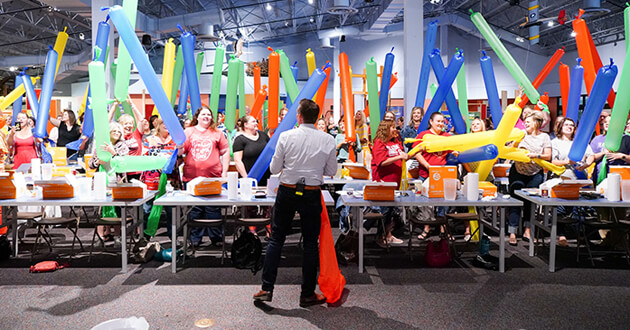
If you were at Weather and Science Day last week, you saw our giant flying sausages, the Solar Bags.

Solar Bags are 50 feet long and are made from a very thin plastic. When inflated, the black plastic heats the air up inside the Solar Bag. The air expands and the bag floats in the air. Our fabulous and dedicated Steve Spangler Science crew ran across the outfield at Coors Field last week to fill the balloons up with air. We filled the stadium with Solar Bags.

Steve also gave 800 teachers, cub scout and girl scout leaders Solar Bags to take back to their group for a hands-on learning experience. If you are a teacher or educator that received a Solar Bag, we have a homework assignment for you. Give your students or kids a little lesson in the

Continue Reading…
May 7, 2012

Instant Ice – Super Cold Water Turns to Ice Before Your Eyes

We recently came across this video by SooToday.com‘s reader Phil Sabine making its rounds on the Internet. In the video, Sabine takes a cold bottle of water, turns it upside down and then taps the bottom. The water instantly begins freezing from the bottom down to the top.

Is it magic? A slight of hand? Or did he switch the liquid in the bottle to something other than water?

The answer to all of the questions is no, there is no trick. The solution lies in the science behind the freezing temperature of water and how ice crystals form. This is also referred to as Supercooled Water.

Everyone knows the freezing temperature of water is 32 degrees Fahrenheit or 0 degrees Celsius. When this temperature is reached, the water molecules freeze by forming ice crystals. It’s easier for the water molecules to turn to ice on top of already formed crystals.  Ice crystals build on existing ice crystals to eventually freeze the entire bottle of water.

What starts the freezing ice crystal process? 

The process of starting the ice crystals is called “nucleation.” This starts from an impurity or scratch or piece of dust on the container holding the water. In this case, the

Continue Reading…
May 4, 2012

Weather and Science Day with 9News, Steve Spangler Science and the Colorado Rockies Reaches All Time High

Our annual Weather and Science Day reached a new height this year with the launch of a weather balloon during the event. The weather balloon was launched with help from The Edge of Space. During it’s flight, it reached the edge of space at a height of 93,000 feet. That’s higher than Mount Everest and higher than what a military jet can fly (50,000 feet). The balloon drifted northeast and landed hours later near Synder, Colorado.

Weather and Science Day May 2012 Courtesy 9News.com

Beaker “piloted” the weather balloon along with three flags from 9News, the Colorado Rockies and Steve Spangler Science. The balloon also had three cameras onboard that recorded hours of flight footage. You can see Beaker at the edge of the heavens and his violent fall back to earth after the balloon ruptured.



Weather Balloon with Beaker. Courtesy 9News.com


The underlying lesson was to work with The Edge of Space people who love flying balloons as hobbyists. Their dedication and passion to ballooning was inspiring.

Launching a balloon from Coors

Continue Reading…